
Complete Guide to SMILE Pro Eye Surgery and Vision Correction

- What Is SMILE Pro Eye Surgery?
- How Does SMILE Pro Eye Surgery Work?
- Conditions That SMILE Pro Can Correct
- Benefits of SMILE Pro Eye Surgery
- Step-by-Step SMILE Pro Procedure
- SMILE Pro Eye Surgery Cost
- Smile Pro Recovery Time and Side Effects
- Is There an Age Limit for SMILE Pro Eye Surgery?
- What Do Smile Eye Surgery Reviews Say?
- Why Choose Vasu Eye & Skin Hospital for SMILE Pro Eye Surgery?
- FAQs
If you’re researching vision correction options in Bathinda, Punjab, Haryana, or northern Rajasthan, you’ve likely come across SMILE Pro considered one of the most advanced laser eye surgery technologies available today. This guide covers what SMILE Pro eye surgery is, how it works, its cost, side effects, age eligibility, and what patients say about it.
What Is SMILE Pro Eye Surgery?
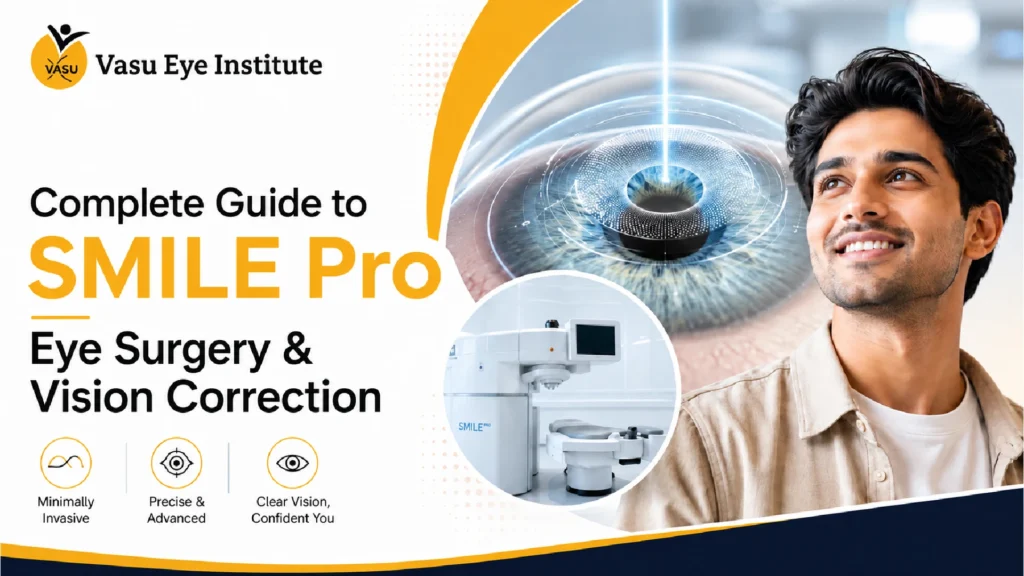
SMILE Pro (Small Incision Lenticule Extraction) is a flapless refractive surgery performed on the ZEISS VISUMAX 800 platform. A femtosecond laser creates a thin lenticule of corneal tissue, which the surgeon removes through a very small incision correcting myopia and, in many cases, astigmatism, without creating a corneal flap.
How Does SMILE Pro Eye Surgery Work?
The SMILE Pro procedure involves three key stages:
- Lenticule creation a femtosecond laser precisely creates a thin lenticule within the corneal layers based on your prescription
- Small incision a tiny incision of just a few millimetres is made at the edge of the treatment area
- Lenticule removal the surgeon carefully extracts the lenticule through this incision, reshaping the cornea to correct your vision
The entire smile pro procedure is typically completed within minutes per eye, performed under topical anaesthesia one reason it’s regarded as one of the most advanced laser eye surgery options for vision correction today.
Conditions That SMILE Pro Can Correct
SMILE Pro is commonly used for:
- Myopia (nearsightedness), across a range of prescription levels
- Astigmatism, in many cases, depending on degree and corneal profile
Whether SMILE Pro is right for your specific prescription depends on a detailed pre-surgery evaluation, not a general rule.
Benefits of SMILE Pro Eye Surgery
- Flapless technique no corneal flap is created, unlike LASIK
- Minimally invasive a smaller incision than flap-based procedures
- Advanced ZEISS VISUMAX 800 technology for precision correction
- Reduced dependency on glasses or contacts for most daily activities
- Quick, in-office procedure with a well-defined recovery process
Individual outcomes vary based on eye health, prescription, and adherence to post-operative care guided by your surgeon.
Step-by-Step SMILE Pro Procedure
- Comprehensive eye evaluation corneal mapping, thickness measurement, refraction check
- Numbing eye drops applied before the procedure
- Femtosecond laser creates the lenticule (a few minutes per eye)
- Surgeon removes the lenticule through the small incision
- Protective eye shield and post-procedure instructions provided
- Scheduled follow-up visits to monitor healing
SMILE Pro Eye Surgery Cost
SMILE Pro eye surgery cost varies depending on the technology used, the depth of the pre-surgery evaluation, and the post-operative care included. Rather than comparing a single figure across hospitals, ask for a written breakdown covering diagnostics, the procedure itself, and follow-up visits. A personalised quote is only possible after your evaluation at Vasu Eye Institute & Skin Centre.
Smile Pro Recovery Time and Side Effects
Many patients report mild discomfort, light sensitivity, or watery eyes in the first day or two, managed with prescribed drops. Many patients resume routine activities within a few days, though exact recovery timelines vary by individual and should follow your surgeon’s specific guidance. As with any surgical procedure, temporary side effects are possible and should be discussed during your consultation.
Is There an Age Limit for SMILE Pro Eye Surgery?
SMILE Pro eye surgery age limit generally starts at 18 years, once the eye prescription has stabilised for at least 12 months. There is no fixed upper age limit eligibility depends more on overall eye health, corneal thickness, and absence of conditions such as active corneal disease.
What Do Smile Eye Surgery Reviews Say?
Patient feedback on SMILE Pro commonly highlights the quick, flapless procedure and the convenience of reduced dependency on glasses. That said, published reviews and testimonials reflect individual experiences and shouldn’t replace your own clinical evaluation every patient’s eyes, prescription, and recovery are different.
Why Choose Vasu Eye & Skin Hospital for SMILE Pro Eye Surgery?
Vasu Eye Institute & Skin Centre in Bathinda is equipped with the ZEISS VISUMAX 800 platform and a dedicated cornea and refractive surgery team led by Dr. Gourav Mangla and Dr. Akash Deep Goel. Every patient undergoes a comprehensive diagnostic evaluation before any procedure is recommended, and we discuss all suitable options for your specific eyes.
FAQs
SMILE Pro is a flapless refractive surgery that uses a femtosecond laser to remove a thin corneal lenticule through a small incision, correcting myopia and, in many cases, astigmatism.
Candidates generally need a stable prescription for at least 12 months, adequate corneal thickness, and no active corneal disease. Eligibility is confirmed only through an in-person evaluation.
The procedure itself is typically completed within minutes per eye, in addition to pre-procedure preparation and evaluation time.
The procedure is performed under topical anaesthesia, so patients typically do not feel pain during surgery. Mild discomfort afterward is managed as advised by your surgeon.
Many patients resume routine work within a few days, though this depends on individual healing and your surgeon's specific advice.
Many patients resume routine activities within a few days, though full recovery timelines vary by individual and should follow your surgeon's specific guidance.
Many patients significantly reduce or eliminate dependency on glasses for daily activities, though some may need reading glasses later due to age-related changes unrelated to the procedure.