
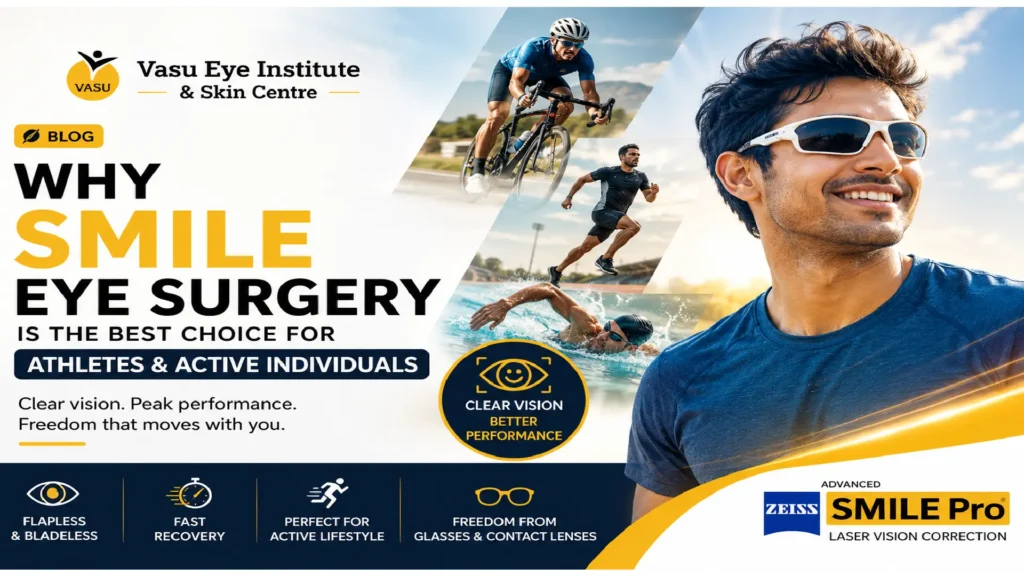
Why SMILE Eye Surgery Is the Best Choice for Athletes and Active Individuals

- Why Is SMILE Eye Surgery a Good Choice for Athletes?
- Benefits of SMILE Eye Surgery for Active Individuals
- Is SMILE Eye Surgery Safe for Sports?
- Best Laser Eye Surgery for Athletes
- SMILE Eye Surgery for Fitness Enthusiasts
- Can Athletes Play Sports After SMILE Eye Surgery?
- SMILE Surgery Recovery for Athletes
- FAQs
Contact lenses that dry out mid-match, glasses that fog or slip during training for athletes and active individuals across Bathinda, Punjab, Haryana, and northern Rajasthan, eyewear can get in the way of performance. Here’s why SMILE eye surgery is drawing attention from this group specifically.
Why Is SMILE Eye Surgery a Good Choice for Athletes?
SMILE (Small Incision Lenticule Extraction) is a flapless refractive procedure performed using advanced femtosecond laser technology such as the ZEISS VISUMAX 800. Because no corneal flap is created, there’s a lower structural risk of flap-related complications from impact a relevant consideration for anyone in contact sports or high-activity training.
Benefits of SMILE Eye Surgery for Active Individuals
- Flapless technique no corneal flap to worry about during high impact activity
- Small incision minimally invasive compared to flap-based procedures
- Reduced dependency on glasses or contacts during training, matches, and outdoor activity
- Convenience no lens maintenance, fogging, or slipping during physical activity
Outcomes vary by individual eye health, sport type, and adherence to post-operative guidance from your surgeon.
Is SMILE Eye Surgery Safe for Sports?
SMILE’s flapless design is often discussed in the context of contact sports because there’s no flap that could theoretically be disturbed by direct impact, unlike flap-based procedures. That said, your surgeon will advise on a specific timeline before returning to contact sports or high-impact training, based on your individual recovery.
Best Laser Eye Surgery for Athletes
There’s no universal “best” procedure for every athlete the right choice depends on your sport, prescription, corneal profile, and recovery timeline needs. SMILE is one option worth discussing alongside LASIK during your evaluation. Read our detailed comparison in why choose SMILE Pro eye surgery for vision correction.
SMILE Eye Surgery for Fitness Enthusiasts
Beyond competitive athletes, fitness enthusiasts gym-goers, runners, swimmers, cyclists often cite similar motivations: eliminating sweat-fogged glasses, avoiding dry contact lenses during intense workouts, and reducing gear to manage during travel for events.
Can Athletes Play Sports After SMILE Eye Surgery?
Many patients resume light activity within a few days and return to full training and contact sports on a timeline set individually by their surgeon, based on healing progress. There is no fixed universal timeline your surgeon will confirm this at follow-up visits.
SMILE Surgery Recovery for Athletes
Recovery guidance typically includes:
- Avoiding eye rubbing and high-impact contact sports until cleared by your surgeon
- Following prescribed eye drop schedules
- Attending all scheduled follow-up evaluations
- Gradually resuming training intensity per your surgeon’s advice
FAQs
Its flapless design means there's no corneal flap to be concerned about during high-impact activity, which is often relevant for athletes and active individuals, though your surgeon will advise on your specific case.
Many patients return to light activity within a few days and full training or contact sports on a timeline confirmed individually by their surgeon based on healing.
Neither is universally better SMILE's flapless technique is often discussed for contact sports specifically, but your surgeon will recommend the most suitable option based on your evaluation.
Timelines vary by individual healing and sport type. Your surgeon will confirm a specific return-to-training schedule during follow-up visits.
Many patients significantly reduce or eliminate dependency on glasses for daily and athletic activities, though outcomes vary by individual.
SMILE is a well-established refractive procedure. Safety and suitability for your activity level depend on a comprehensive pre-surgery eye evaluation.