
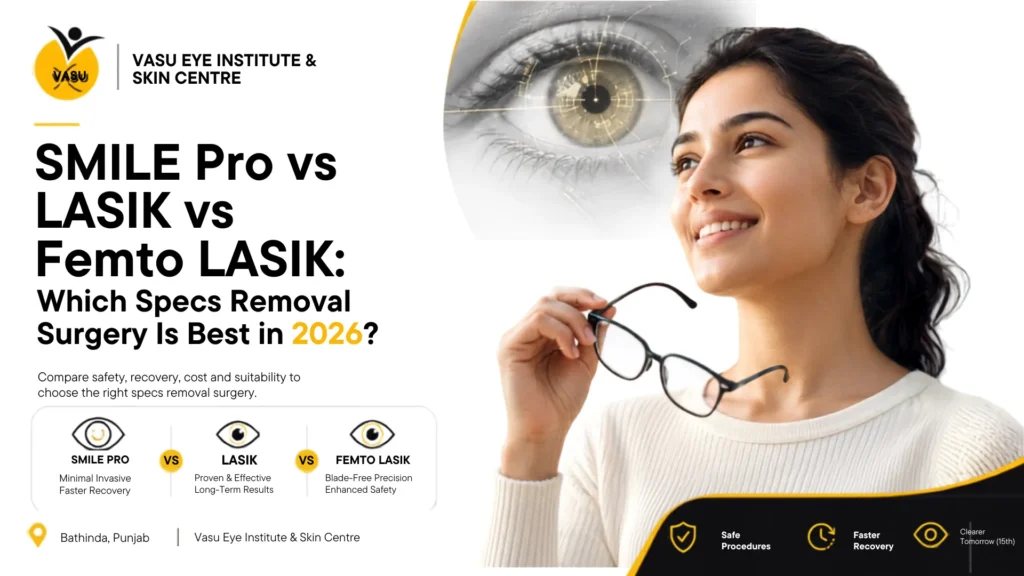
SMILE Pro vs LASIK vs Femto LASIK: Which Specs Removal Surgery Is Best in 2026?

- Understanding the Three Procedures
- SMILE Pro vs LASIK vs Femto LASIK: Side-by-Side Comparison
- Which Procedure Is Safer?
- Which Has the Fastest Recovery?
- WWhich Is Best for High Prescription (High Myopia)?
- Which Is Best for Patients With Thin Corneas?
- Which Is Best for Active or Sporty Patients?
- SMILE Pro vs LASIK vs Femto LASIK: Cost Difference in Bathinda, Punjab
- How to Choose Between SMILE Pro , Femto LASIK, and LASIK
- Book Your Eye Evaluation at Vasu Eye Institute, Bathinda
- FAQs
If you are considering permanent vision correction in 2026, you have three main laser surgery options: Traditional LASIK, Femto LASIK (Bladeless LASIK), and SMILE Pro+ Each works differently, suits different patients, and comes at a different price point.
This guide compares all three procedures side by side technology, safety, recovery, cost, and candidacy so you can make an informed decision before your consultation.
All three procedures LASIK, Femto LASIK, and SMILE Pro are available at Vasu Eye Institute, Bathinda. Your surgeon will recommend the most suitable option after a comprehensive eye evaluation.
Understanding the Three Procedures
Before comparing them, here is a plain-language explanation of each procedure.
What Is Traditional LASIK?
Traditional LASIK (Laser-Assisted In Situ Keratomileusis) uses a microkeratome blade to create a thin corneal flap. The flap is lifted, an Excimer laser reshapes the cornea to correct the refractive error, and the flap is repositioned. It is the most widely performed laser eye surgery in the world and has a long, well-established safety record.
Best suited for: patients with mild to moderate myopia (up to −8D) who are on a tighter budget.
What Is Femto LASIK (Bladeless LASIK)?
Femto LASIK replaces the microkeratome blade with a femtosecond laser to create the corneal flap hence ‘bladeless LASIK‘. The rest of the procedure is identical to LASIK: flap is lifted, Excimer laser reshapes the cornea, flap is replaced. The femtosecond laser provides a more precise, customisable flap than a blade.
Best suited for: patients who want the reassurance of a bladeless flap creation but LASIK-level pricing.
What Is SMILE Pro ?
SMILE Pro is the most advanced option. It is entirely flapless no flap is created at all. The ZEISS VisuMax 800 laser creates a small disc of corneal tissue (a lenticule) in just 9 seconds, which is extracted through a 2–3mm incision. No blade. No flap. Minimal corneal surface disruption.
Best suited for: patients with moderate to high myopia (up to −10D), dry eye tendencies, athletes, or anyone seeking the lowest possible complication risk.
SMILE Pro vs LASIK vs Femto LASIK: Side-by-Side Comparison
| Comparison Factor | Traditional LASIK | Femto LASIK | SMILE Pro ★ |
|---|---|---|---|
| Technique | Blade + Excimer laser | Femtosecond + Excimer laser | Femtosecond laser only (flapless) |
| Corneal Flap | Yes — 20mm flap | Yes — smaller flap | No flap at all ✓ |
| Incision Size | ~20mm | ~18mm | 2–3mm only ✓ |
| Laser Time | 20–30 seconds | 15–20 seconds | 9 seconds ⚡ Fastest |
| Dry Eye Risk | High | Moderate | Very Low ✓ |
| Flap Complications | Possible | Possible | Zero (no flap) ✓ |
| Corneal Nerves Cut | Significant | Moderate | Minimal ✓ |
| Myopia Range | Up to −8D | Up to −9D | Up to −10D ✓ |
| Astigmatism Range | Up to −3D | Up to −4D | Up to −5D ✓ |
| Thin Cornea Eligible | Limited | Limited | Better option ✓ |
| Sports Safety | Caution required | Caution required | Fully safe ✓ |
| Recovery (vision) | 24 hours | 24 hours | 24–48 hours |
| Pain / Discomfort | Mild | Mild | Minimal ✓ |
| Technology | Older (microkeratome) | Advanced (femtosecond) | Most advanced ✓ |
| Approx. Cost (both eyes) | ₹30,000–₹50,000 | ₹50,000–₹80,000 | ₹80,000–₹1,20,000 |
| FDA Approved | Yes | Yes | Yes ✓ |
| Available at Vasu Eye Institute | Yes | Yes | Yes ✓ |
★ SMILE Pro columns are highlighted in yellow above it leads on safety, technology, and candidacy range. Traditional LASIK remains the most cost-effective option for patients with mild prescriptions.
Which Procedure Is Safer?
All three procedures have excellent safety profiles. However, they are not equal when it comes to specific risk categories:
Dry Eye Risk: SMILE Pro wins. Because no corneal flap is created, far fewer corneal nerves are severed. Clinical studies show SMILE Pro patients report significantly less post-operative dry eye compared to LASIK and Femto LASIK.
Flap Complications: SMILE Pro wins. Traditional and Femto LASIK both carry flap-related risks flap displacement, flap folds, or epithelial ingrowth under the flap. SMILE Pro eliminates these entirely since no flap is created.
Infection Risk: All three are comparable. The smaller incision in SMILE Pro (2–3mm vs 20mm flap) theoretically reduces exposure surface, but infection risk is extremely low across all three procedures when performed in a sterile surgical environment.
Verdict: SMILE Pro offers the safest profile particularly for patients with existing dry eye or those in high-contact occupations or sports.
Which Has the Fastest Recovery?
Recovery speed is comparable across all three procedures, but there are nuances:
- Traditional LASIK: Vision stabilises within 24 hours for most patients. The flap takes 3–6 months to fully integrate.
- Femto LASIK: Similar to LASIK functional vision within 24 hours, full stability over weeks to months.
- SMILE Pro : Vision typically stabilises within 24–48 hours. Because no flap is created and the incision is only 2–3mm, the cornea heals faster with less surface disruption.
Verdict: SMILE Pro has a slight edge in overall corneal healing though day-to-day functional recovery is similar across all three.
Which Is Best for High Prescription (High Myopia)?
If your myopia is higher than −6.00D, SMILE Pro is the clear front-runner:
- Traditional LASIK: approved up to −8D, but outcomes at higher powers can be less predictable due to flap thickness constraints.
- Femto LASIK: approved up to −9D, better flap control, improved outcomes at higher prescriptions.
- SMILE Pro : approved up to −10D, and because the flapless design preserves more corneal biomechanical strength, outcomes are typically more predictable at high myopia.
Verdict: SMILE Pro is the best option for myopia above −6D and the only option approved up to −10D.
Which Is Best for Patients With Thin Corneas?
Corneal thickness is a critical candidacy factor for all laser procedures. Both LASIK and Femto LASIK require enough tissue for both the flap and the laser ablation beneath it. SMILE Pro requires no flap, meaning less total corneal tissue is removed making it a viable option for some patients with slightly thinner corneas who are not ideal LASIK candidates.
Important: Thin cornea eligibility is not automatic a corneal topography scan and pachymetry (thickness measurement) at Vasu Eye Institute will determine eligibility precisely.
Verdict: SMILE Pro is the preferred option for borderline corneal thickness, but evaluation is required to confirm.
Which Is Best for Active or Sporty Patients?
This is one of the strongest differentiators for SMILE Pro :
- LASIK and Femto LASIK: both create a corneal flap that while well-healed can theoretically be displaced by a direct blow to the eye. Most surgeons advise contact sport athletes against these procedures or require a recovery period of 4–6+ weeks before returning to contact sport.
- SMILE Pro : no flap means no flap displacement risk. The 2–3mm incision heals rapidly. Athletes, military personnel, police officers, and gym-goers frequently prefer SMILE Pro for this reason.
Verdict: SMILE Pro is the unanimous choice for active patients, athletes, and anyone in a physically demanding profession.
SMILE Pro vs LASIK vs Femto LASIK: Cost Difference in Bathinda, Punjab
Below is a typical cost range for all three procedures at Vasu Eye Institute, Bathinda. Exact pricing depends on your prescription level, diagnostic requirements, and the package selected.
| Procedure | Approx. Cost (Both Eyes) | Technology Used | Best For |
|---|---|---|---|
| Traditional LASIK | ₹30,000–₹50,000 | Microkeratome blade + Excimer laser | Mild myopia, budget-conscious |
| Femto LASIK | ₹50,000–₹80,000 | Femtosecond + Excimer laser | Moderate myopia, bladeless preference |
| SMILE Pro ★ | ₹80,000–₹1,20,000 | ZEISS VisuMax 800 (flapless) | High myopia, dry eye, sports, best outcomes |
Note: LASIK is the most budget-friendly option. However, its lower cost reflects older technology and a higher dry eye risk. SMILE Pro represents a higher upfront investment with superior long-term outcomes particularly for patients with high myopia or active lifestyles.
A useful way to think about cost: most patients spend ₹10,000–₹20,000 per year on glasses, contact lenses, and related expenses. SMILE Pro pays for itself within 5–8 years and provides permanent, glasses-free vision.
How to Choose Between SMILE Pro , Femto LASIK, and LASIK
The right procedure depends on your individual profile. Use this as a starting guide not a substitute for a specialist evaluation:
Choose SMILE Pro if:
- Myopia above −6D or astigmatism above −3D
- You have dry eye symptoms or dry eye history
- You are an athlete, play contact sports, or have a physically active job
- You want the lowest possible complication risk
- You have borderline corneal thickness
Choose Femto LASIK if:
- Myopia in the −3D to −7D range
- Budget is a consideration but you want a bladeless procedure
- You have normal corneal thickness and no dry eye history
Choose Traditional LASIK if:
- Mild myopia (−1D to −5D) with normal corneal thickness
- Budget is a primary concern
- You have been evaluated and are an excellent LASIK candidate
Not sure which is right for you? At Vasu Eye Institute, Bathinda will map your cornea, measure dry eye levels, and give you a clear, surgeon-backed recommendation same day.
Book Your Eye Evaluation at Vasu Eye Institute, Bathinda
Still unsure whether SMILE Pro, Femto LASIK, or traditional LASIK is right for you? The answer depends on your prescription, corneal thickness, lifestyle, and eye health all of which can be assessed at a single consultation.
Vasu Eye Institute in Bathinda is equipped with all three technologies and the ZEISS VisuMax 800 for SMILE Pro. Our refractive surgery team will give you a clear, personalised recommendation with no obligation to proceed.
Consultations available Monday to Saturday. Bring your current glasses or contact lens prescription. Same-day evaluation results.
FAQs
LASIK creates a 20mm corneal flap before reshaping the eye. SMILE Pro is completely flapless a tiny lenticule is removed through a 2–3mm incision with no blade and no flap. This eliminates flap-related complications and significantly reduces dry eye risk.
Both procedures are safe and have excellent track records. SMILE Pro has a lower risk of dry eye syndrome and zero flap-related complications, making it preferable for patients with dry eye tendencies, high myopia, or active lifestyles.
Both LASIK and SMILE Pro offer functional vision within 24–48 hours. SMILE Pro has a slight advantage in corneal healing speed due to the smaller 2–3mm incision versus the 20mm flap in LASIK, but day-to-day recovery is similar.
In many cases, yes. SMILE Pro removes less corneal tissue than LASIK because no flap is created. However, a detailed corneal thickness measurement (pachymetry) is required before surgery. Your surgeon at Vasu Eye Institute will confirm candidacy.
Yes. SMILE Pro using the ZEISS VisuMax 800 costs more than standard LASIK due to advanced technology. However, it offers significantly better outcomes for high myopia and active patients, and the majority of patients find the investment worthwhile long term.
SMILE Pro is the unanimous preference for athletes. The flapless design means there is no risk of flap displacement from physical impact, making it safe for contact sports, gym, swimming, and military or police service. LASIK and Femto LASIK require greater caution post-surgery.
Yes. SMILE Pro corrects myopia up to −10.00D and astigmatism up to −5.00D. It cannot currently correct hyperopia (long-sightedness). Patients with hyperopia may be better suited for ICL surgery.