
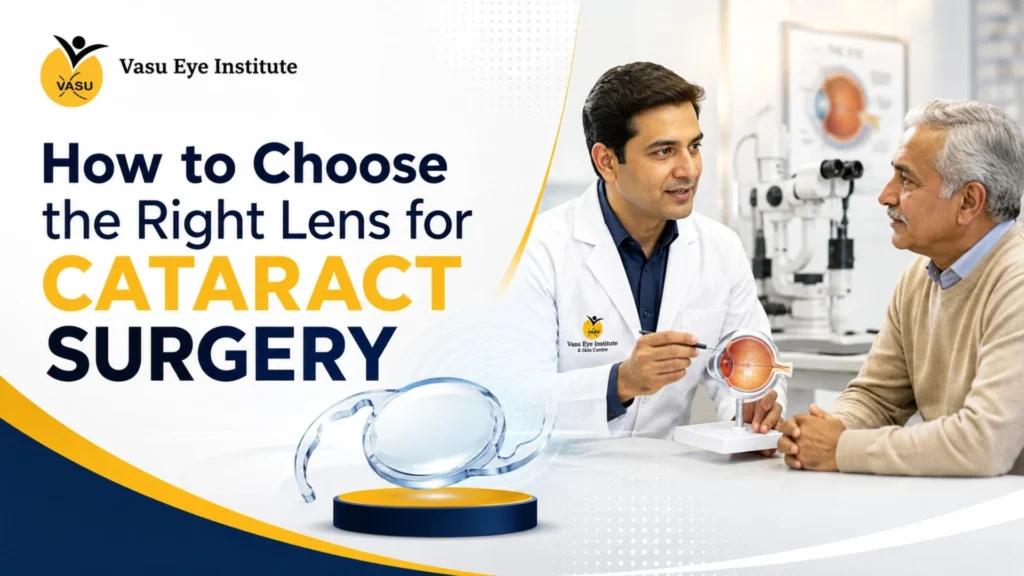
How to Choose the Right Lens for Cataract Surgery

- Why Choosing the Right Lens Matters in Cataract Surgery
- Different Types of Cataract Lenses Used in Cataract Surgery
- Factors to Consider When Choosing a Cataract Surgery Lens
- Monofocal vs Multifocal vs EDOF Lenses
- Can the Same Cataract Lens Be Used for Everyone?
- Tests Your Eye Doctor May Perform Before Choosing an IOL
- Cataract Surgery Lens Cost
- Why Choose Vasu Eye & Skin Hospital for Cataract Surgery?
- FAQs
Cataracts treatment today involves more than removing the clouded natural lens it also means choosing a replacement intraocular lens (IOL) suited to your vision needs and lifestyle. Finding the best lens for cataract surgery isn’t about a single universal answer; it’s about matching lens type to your eyes. For patients across Bathinda, Punjab, Haryana, and northern Rajasthan, here’s what to know before deciding.
Why Choosing the Right Lens Matters in Cataract Surgery
The lens used in cataract surgery replaces your eye’s natural, clouded lens and plays a significant role in your vision after surgery including how well you see at different distances and your dependency on glasses afterward. Getting this choice right, based on a proper evaluation, matters as much as the surgery itsel
Different Types of Cataract Lenses Used in Cataract Surgery
There are several cataract surgery lens options available today, each suited to different vision needs:
Monofocal Lenses
Monofocal lenses correct vision clearly at one distance usually far vision with glasses often still needed for near tasks like reading.
Multifocal Lenses
Multifocal lenses are designed to provide clear vision at multiple distances, potentially reducing dependency on glasses for both near and far tasks, though visual outcomes vary by individual.
Trifocal Lens
A trifocal lens extends this further, targeting near, intermediate, and far vision in a single lens design.
EDOF Lens
An EDOF (Extended Depth of Focus) lens provides a continuous range of vision, often prioritising intermediate and distance vision with potentially fewer visual disturbances than some multifocal designs, depending on the individual.
Toric Lens
A toric lens is specifically designed to correct astigmatism alongside cataract removal, for patients with this additional refractive error.
Factors to Consider When Choosing a Cataract Surgery Lens
- Your daily visual needs reading, driving, screen use, or a mix of all three
- Whether you have astigmatism, which may point toward a toric option
- Your tolerance for wearing glasses after surgery for certain tasks
- Overall eye health, including conditions like macular degeneration or glaucoma that may affect suitability for certain lens types
- Cataract surgery lens cost considerations relevant to your chosen lens category
Monofocal vs Multifocal vs EDOF Lenses
| Factor | Monofocal | Multifocal | EDOF |
|---|---|---|---|
| Distance covered | Single distance (usually far) | Multiple distances | Extended, continuous range |
| Glasses dependency | Often needed for near tasks | Potentially reduced across distances | Often reduced for intermediate/far |
| Visual disturbances | Generally minimal | Possible glare/halos for some patients | Generally fewer than some multifocal designs |
For cataract surgery, which lens is best depends entirely on your individual eyes, lifestyle, and eye health there’s no single universally “best” option.
Can the Same Cataract Lens Be Used for Everyone?
No. Lens selection is individualised based on your eye measurements, any pre-existing conditions, and your visual priorities. What suits one patient’s lifestyle and eye health may not suit another’s, even with a similar cataract diagnosis.
Tests Your Eye Doctor May Perform Before Choosing an IOL
- Biometry to measure the eye’s shape and length for precise lens power calculation
- Corneal topography, particularly relevant if considering a toric lens
- Assessment of retinal and macular health
- Discussion of your lifestyle, hobbies, and visual priorities
Cataract Surgery Lens Cost
Cataract surgery lens cost varies significantly depending on the lens category chosen monofocal, multifocal, trifocal, EDOF, or toric along with the surgical technology and post-operative care included. We recommend a personalised consultation for a transparent cost breakdown based on your specific eye evaluation and lens choice.
Why Choose Vasu Eye & Skin Hospital for Cataract Surgery?
At Vasu Eye Institute & Skin Centre in Bathinda, our team led by Dr. Gourav Mangla and Dr. Akash Deep Goel conducts a comprehensive evaluation before recommending any cataract surgery lens option, ensuring the choice matches your specific vision needs, eye health, and lifestyle.
FAQs
There's no universally "best" lens the right choice depends on your individual vision needs, astigmatism status, and overall eye health, confirmed through evaluation.
Common types include monofocal, multifocal, trifocal, EDOF, and toric lenses, each suited to different visual priorities and eye conditions.
Neither is universally better multifocal lenses may reduce glasses dependency across distances, but they carry different considerations than monofocal lenses, discussed individually with your surgeon.
An EDOF (Extended Depth of Focus) lens provides a continuous range of vision, often prioritising intermediate and distance vision.
Yes, toric lenses are specifically designed to correct astigmatism alongside cataract removal, for suitable candidates.
This depends on the lens type chosen and your individual eyes. Some patients still need glasses for certain tasks, such as reading, even with advanced lens options.
A comprehensive eye evaluation, including biometry and a discussion of your lifestyle and visual priorities, is the only reliable way to determine the right lens for you.