
Common Myths and Facts About SMILE Pro Eye Surgery

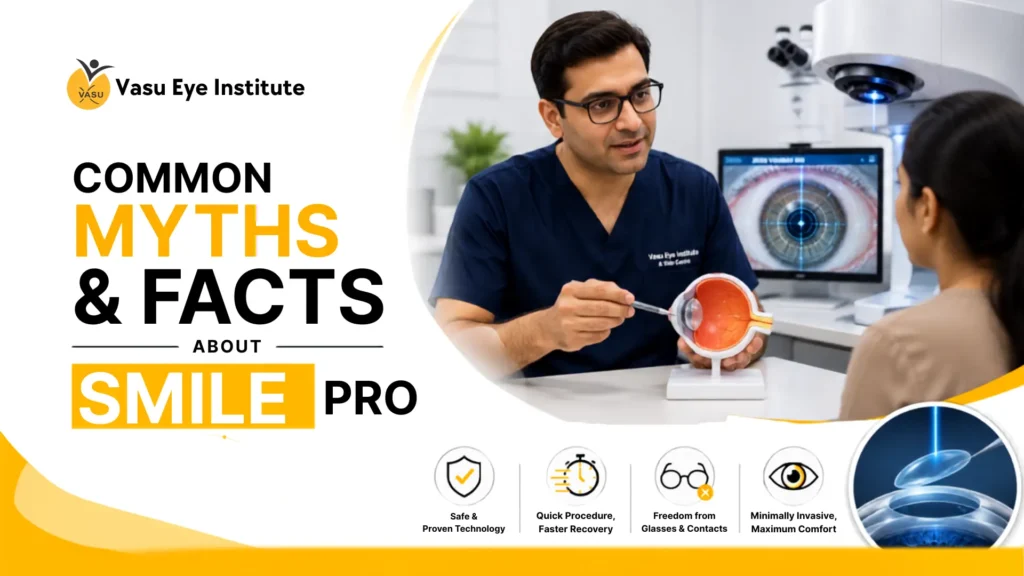
Every day at our Bathinda clinic, patients from across Punjab, Haryana, and northern Rajasthan arrive with questions shaped as much by rumours as by facts. SMILE Pro, being a newer specs-removal technology, attracts a fair share of misconceptions. Here’s what’s true and what isn’t.
What Is SMILE Pro Eye Surgery?
SMILE Pro (Small Incision Lenticule Extraction) is a flapless refractive surgery performed on the ZEISS VISUMAX 800 platform. A femtosecond laser creates a thin lenticule inside the cornea, which the surgeon removes through a very small incision correcting myopia and, in many cases, astigmatism without creating a corneal flap.
Why Are There So Many Myths About SMILE Pro?
SMILE Pro is a relatively newer technology compared to LASIK in many markets, and patients often rely on word-of-mouth, unverified social media posts, or outdated information about older laser techniques. Below, we separate common myths from clinical facts.
Myth: SMILE Pro Is Extremely Painful
Fact: The procedure is performed under topical (numbing eye drop) anaesthesia. Most patients report only mild pressure sensation during the procedure, not pain. Any post-procedure discomfort is typically managed with prescribed drops.
Myth: Recovery Takes Weeks
Fact: Because SMILE Pro is flapless and minimally invasive, many patients resume routine activities within a few days. Exact recovery timelines depend on individual healing and should follow your surgeon’s guidance.
Myth: SMILE Pro Is Only for Very Low Eye Power
Fact: SMILE Pro is used for a range of myopia levels and, in many cases, astigmatism. Suitability for high eye power is determined by corneal thickness and shape during pre-surgery evaluation not by a fixed rule of thumb.
Myth: All Specs-Removal Surgeries Are the Same
Fact: LASIK, PRK, and SMILE Pro all correct refractive errors differently. SMILE Pro’s flapless technique is a key structural difference from LASIK, which involves creating and lifting a corneal flap. Read our comparison in why choose SMILE Pro eye surgery for vision correction for a detailed breakdown.
Myth: Results Are Temporary
Fact: SMILE Pro corrects the refractive error present at the time of surgery, and results are generally stable long term. Like any refractive procedure, it does not prevent unrelated, age related vision changes later in life.
Myth: Anyone Can Get SMILE Pro Without Tests
Fact: A comprehensive eye evaluation corneal mapping, thickness measurement, and overall eye health assessment is mandatory before any surgeon can confirm eligibility for SMILE Pro.
Tips Before Choosing SMILE Pro Surgery
- Insist on a detailed pre-surgery evaluation, not just a quick screening
- Ask your surgeon directly about flap-based vs flapless techniques and which suits your eyes
- Verify the hospital’s technology SMILE Pro requires a femtosecond laser platform such as ZEISS VISUMAX 800
- Discuss realistic expectations and recovery timeline for your specific case
- Avoid relying solely on online reviews or social media claims for medical decisions
FAQs
No the procedure uses topical anaesthesia, and most patients report only mild pressure, not pain, during surgery.
The procedure itself is typically completed within minutes per eye, in addition to pre-procedure preparation time.
Many patients resume routine work within a few days, though this depends on individual healing and your surgeon's specific advice.
SMILE Pro and LASIK have different techniques and risk profiles. Neither is universally "safer" your surgeon will recommend the most suitable option based on your eye evaluation.
Eligibility depends on stable prescription, corneal thickness, and overall eye health, confirmed only through an in-person evaluation.
Suitability depends on corneal thickness and shape rather than eye power alone. A pre-surgery evaluation determines whether SMILE Pro is appropriate for your prescription.