
Who Is Eligible for SMILE Pro Eye Surgery? Age, Power and Cornea Requirements Explained

- Quick Eligibility Self-Check
- What Is the Minimum Age for SMILE Pro Eye Surgery?
- What Is the Maximum Age Limit for SMILE Pro?
- What Prescription (Power) Is Suitable for SMILE Pro?
- What Corneal Thickness Is Required for SMILE Pro?
- Other Eligibility Criteria for SMILE Pro Surgery
- Who Should NOT Get SMILE Pro Eye Surgery?
- What Happens During a SMILE Pro Eligibility Evaluation at Vasu Eye Institute?
- Book Your SMILE Pro Eligibility Check at Vasu Eye Institute, Bathinda
- FAQs
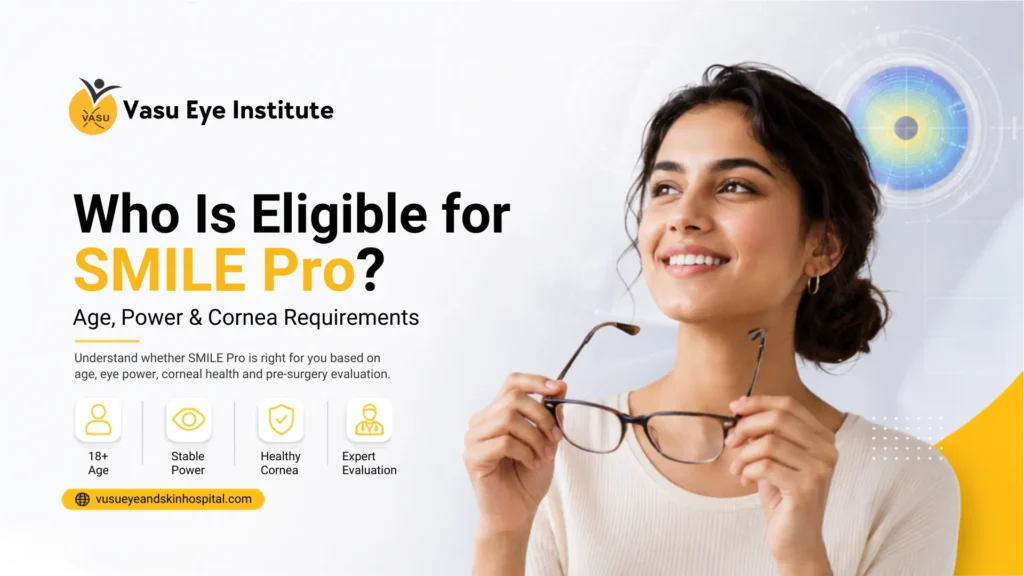
One of the most common questions patients ask before considering SMILE Pro is: ‘Am I eligible?’ The answer depends on several factors your age, your prescription strength, the thickness of your cornea, and your overall eye health.
This guide covers every eligibility criterion for SMILE Pro eye surgery in plain language including who qualifies, who does not, and what happens during a pre-surgery evaluation at Vasu Eye Institute, Bathinda.
Quick Eligibility Self-Check
| ✓/✗ | Eligibility Criterion | Your Status (fill in) |
|---|---|---|
| - | Age 18 years or above (21+ recommended) | |
| - | Prescription stable for at least 12 months | |
| - | Myopia: −1.00D to −10.00D | |
| - | Astigmatism: up to −5.00D (if applicable) | |
| - | No hyperopia (long-sightedness) correction needed | |
| - | No active eye infection or corneal disease | |
| - | No keratoconus (irregular cornea) | |
| - | Not pregnant or breastfeeding | |
| - | Adequate corneal thickness (confirmed by scan) | |
| - | Dry eye condition is mild or absent | |
| - | No autoimmune or uncontrolled systemic disease |
If you ticked all boxes, you are likely a strong candidate for SMILE Pro. If you have any uncertainties, an evaluation at Vasu Eye Institute will give you a definitive answer.
What Is the Minimum Age for SMILE Pro Eye Surgery?
The minimum age for SMILE Pro surgery is 18 years. However, most refractive surgeons — including the team at Vasu Eye Institute recommend waiting until at least 21 years of age.
The reason: during your teens and early twenties, the prescription (glasses power) may still be changing as the eye continues to develop. If SMILE Pro is performed while the prescription is still shifting, additional correction may be needed later.
The 21+ recommendation is not a hard rule some 18–20 year olds have highly stable prescriptions and are excellent candidates. Your surgeon will assess this based on your prescription history over the past 12–24 months.
Minimum age: 18 years (surgery performed). Recommended age: 21+ years (prescription fully stable).
What Is the Maximum Age Limit for SMILE Pro?
There is no strict upper age limit for SMILE Pro surgery. Patients in their 30s, 40s, and even 50s can be suitable candidates — provided their prescription is stable and corneal health is adequate.
However, patients above 40 years of age should be aware of one important consideration: presbyopia. Presbyopia is the natural age-related loss of near vision (difficulty reading small print or phone screens) that typically begins in the early-to-mid 40s. SMILE Pro corrects distance vision (myopia and astigmatism) but does not address presbyopia.
What this means in practice:
- A 45-year-old with myopia who gets SMILE Pro will see clearly in the distance without glasses but may need reading glasses for close work due to presbyopia.
- This is not a reason to avoid SMILE Pro, but it is an important conversation to have with your surgeon before proceeding.
- Some patients in their 40s+ opt for monovision correction one eye focused for distance, one for near to reduce dependence on reading glasses.
Verdict: SMILE Pro is suitable at any age above 18, with no strict upper limit. Patients 40+ should discuss presbyopia management with their surgeon.
What Prescription (Power) Is Suitable for SMILE Pro?
SMILE Pro is approved to correct two types of refractive error: myopia (short-sightedness) and astigmatism. Here are the specific ranges:
Myopia: −1.00 diopters to −10.00 diopters | Astigmatism: up to −5.00 diopters
How does SMILE Pro compare to other procedures on prescription range?
| Vision Problem | SMILE Pro | LASIK / Femto LASIK | ICL |
|---|---|---|---|
| Myopia (Short-sight) | −1.00D to −10.00D ✓ | −1.00D to −9.00D | Up to −20.00D |
| Astigmatism | Up to −5.00D ✓ | Up to −4.00D | Up to −6.00D |
| Hyperopia (Long-sight) | Not approved ✗ | Up to +5.00D | Up to +10.00D |
| Mixed Astigmatism | Case-dependent | Case-dependent | Case-dependent |
Important note: SMILE Pro cannot currently correct hyperopia (long-sightedness or plus power). If your glasses prescription shows a plus (+) number for sphere, you will need to discuss alternatives such as LASIK or ICL with your surgeon.
What Corneal Thickness Is Required for SMILE Pro?
Corneal thickness measured in microns (μm) using a test called pachymetry is one of the most critical eligibility factors for any laser eye surgery. The cornea must be thick enough to safely accommodate the lenticule removal while leaving adequate residual tissue.
General guidelines for SMILE Pro:
- Minimum pre-surgery corneal thickness: typically 480–500 μm (microns), though this varies by individual case and surgeon preference.
- Residual stromal bed after surgery: ideally at least 250 μm of stromal tissue must remain after the lenticule is removed.
- SMILE Pro vs LASIK: because SMILE Pro creates no flap, it preserves more corneal biomechanical integrity than LASIK making it suitable for some patients with thinner corneas who would not qualify for LASIK.
Your corneal thickness is measured precisely during the pre-surgery evaluation using corneal topography and Pentacam scanning. You cannot self-assess this only a clinical measurement can confirm it.
If your corneal thickness is below the safe threshold for SMILE Pro or LASIK, ICL (Implantable Collamer Lens) surgery may be the recommended alternative. Vasu Eye Institute offers ICL surgery as well.
Other Eligibility Criteria for SMILE Pro Surgery
Beyond age, prescription, and corneal thickness, the following factors are assessed before any SMILE Pro recommendation is made:
1. Stable Prescription for at Least 12 Months
This is a firm requirement. Your glasses or contact lens prescription must not have changed significantly in the 12 months before surgery. If your power has shifted by more than 0.50D in the past year, surgery is typically postponed until stability is confirmed over a longer period.
Practical check: compare your last two or three prescriptions from your optometrist. If the numbers are the same or within 0.25D, you likely meet this criterion.
2. No Active Eye Infections or Corneal Disease
Any active conjunctivitis, blepharitis (eyelid inflammation), corneal ulcer, or uveitis must be fully resolved before SMILE Pro can be performed. Chronic conditions such as keratoconus (progressive corneal thinning) are typically a contraindication for all laser procedures.
3. Not Pregnant or Breastfeeding
Hormonal changes during pregnancy and breastfeeding alter the cornea’s shape and the prescription. Surgery performed during this period may not produce stable outcomes. SMILE Pro should be postponed until at least 3 months after breastfeeding has stopped and the prescription has restabilised.
4. Dry Eye Assessment
This is where SMILE Pro has a significant advantage over LASIK. Because no corneal flap is created, SMILE Pro severs far fewer corneal nerves meaning it has a substantially lower risk of causing or worsening dry eye.
Eligibility for dry eye patients:
- Mild dry eye: typically NOT a disqualifying factor for SMILE Pro. May still be contraindicated for LASIK.
- Moderate dry eye: assessed case by case. Pre-treatment with lubricating drops before surgery is often recommended.
- Severe, uncontrolled dry eye syndrome: is a contraindication for SMILE Pro. Treatment of the dry eye condition first is required.
Who Should NOT Get SMILE Pro Eye Surgery?
Being transparent about contraindications is part of responsible patient education. Below are the conditions that typically make SMILE Pro unsuitable along with alternative options where applicable:
| Disqualifying Condition | Why SMILE Pro May Not Be Suitable |
|---|---|
| Age under 18 years | The cornea and prescription may still be developing. Surgery before 18 is not recommended. |
| Rapidly changing prescription | Surgery should be postponed until the power has been stable for at least 12 months. |
| Hyperopia (long-sightedness) | SMILE Pro does not currently correct long-sightedness. ICL or LASIK may be options. |
| Keratoconus | A progressive thinning of the cornea that makes laser surgery unsafe. ICL is often recommended. |
| Severe dry eye syndrome | Severe, uncontrolled dry eye is a contraindication. Mild dry eye can often still qualify. |
| Active eye infection or uveitis | Any active inflammation or infection must be fully treated before surgery can be considered. |
| Very thin cornea | Insufficient corneal tissue remaining after surgery would be unsafe. ICL is an alternative. |
| Autoimmune conditions | Conditions like lupus, rheumatoid arthritis, or Sjögren's syndrome may impair healing. |
| Pregnant or breastfeeding | Hormonal changes affect refraction. Surgery must wait until after breastfeeding has stopped. |
| Uncontrolled diabetes | Poorly controlled diabetes can impair healing and affect outcomes. Well-controlled cases may qualify. |
Important: Not qualifying for SMILE Pro does not mean you have no options. Femto LASIK, ICL, or other procedures may be suitable. A comprehensive evaluation at Vasu Eye Institute will identify the safest and most effective solution for your specific eyes.
What Happens During a SMILE Pro Eligibility Evaluation at Vasu Eye Institute?
A pre-surgery evaluation at Vasu Eye Institute is a comprehensive, same-day assessment that takes approximately 60–90 minutes. Here is exactly what it involves:
| # | Test / Step | What It Assesses |
|---|---|---|
| Step 1 | Refraction Test | Precise measurement of your current prescription (glasses power). |
| Step 2 | Corneal Topography | Maps the shape, curvature and thickness of your cornea — the most critical test for SMILE Pro eligibility. |
| Step 3 | Pachymetry | Measures corneal thickness in microns to confirm adequate tissue remains after surgery. |
| Step 4 | Dry Eye Assessment | Schirmer test and tear film evaluation to assess dry eye severity and predict post-surgery comfort. |
| Step 5 | Pupil Mapping | Measures pupil size in low light to plan the treatment zone and minimise night vision side effects. |
| Step 6 | Surgeon Consultation | Your refractive surgeon reviews all results, confirms eligibility, recommends the best procedure, and answers questions. |
After the evaluation, your surgeon will tell you:
- Whether you are eligible for SMILE Pro (or an alternative procedure)
- Your personalised prescription correction plan
- Expected outcomes and realistic vision targets post-surgery
- The exact cost of your procedure and package options
The evaluation carries no obligation to proceed with surgery.
Book Your SMILE Pro Eligibility Check at Vasu Eye Institute, Bathinda
The only way to know with certainty whether you qualify for SMILE Pro is through a comprehensive clinical evaluation. No self-assessment guide can replace a corneal topography scan and a specialist review.
At Vasu Eye Institute, Bathinda, your pre-surgery evaluation covers every eligibility test described above corneal mapping, refraction, dry eye assessment, and a surgeon consultation with no charge and no obligation to proceed.
If SMILE Pro is not the right fit for you, your surgeon will recommend the most appropriate alternative from LASIK, Femto LASIK, or ICL all available at Vasu Eye Institute.
Available Monday to Saturday. Bring your current glasses prescription and any previous prescription records from the past 2 years. Results provided same day.
FAQs
The minimum age for SMILE Pro surgery is 18 years. Most surgeons recommend waiting until at least 21, when the prescription has typically stabilised. Some patients aged 18–20 with demonstrably stable prescriptions may still qualify your surgeon will assess your prescription history.
There is no strict upper age limit. Patients in their 30s, 40s, and 50s can be eligible if their prescription is stable and corneal health is good. Patients above 40 should discuss presbyopia (age-related near vision loss) with their surgeon, as SMILE Pro does not address this.
SMILE Pro corrects myopia (short-sightedness) from −1.00 to −10.00 diopters and astigmatism up to −5.00 diopters. It cannot currently correct hyperopia (long-sightedness). Patients with hyperopia or prescriptions outside this range should discuss LASIK or ICL with their surgeon.
Yes. Your prescription must have been stable with no more than 0.50D change for at least 12 months before surgery. If your power is still fluctuating, surgery should be postponed until stability is confirmed. Compare your last two or three prescriptions to check.
SMILE Pro may suit some patients with borderline corneal thickness better than LASIK, because no flap is created preserving more corneal biomechanical strength. However, there is still a minimum thickness threshold. A corneal topography scan and pachymetry at Vasu Eye Institute will determine your eligibility precisely.
Mild dry eye is not an absolute contraindication for SMILE Pro and SMILE Pro actually carries a significantly lower dry eye risk than LASIK, because no corneal flap is created. Severe, uncontrolled dry eye syndrome may disqualify a patient. A pre-surgery dry eye assessment will confirm your suitability.
Book a pre-surgery eligibility evaluation at Vasu Eye Institute, Bathinda. The assessment including corneal topography, refraction, pachymetry, and dry eye test is performed in a single visit and gives you a same-day answer on your candidacy.