

How Choose Between LASIK and ICL Based on Your Eye Condition

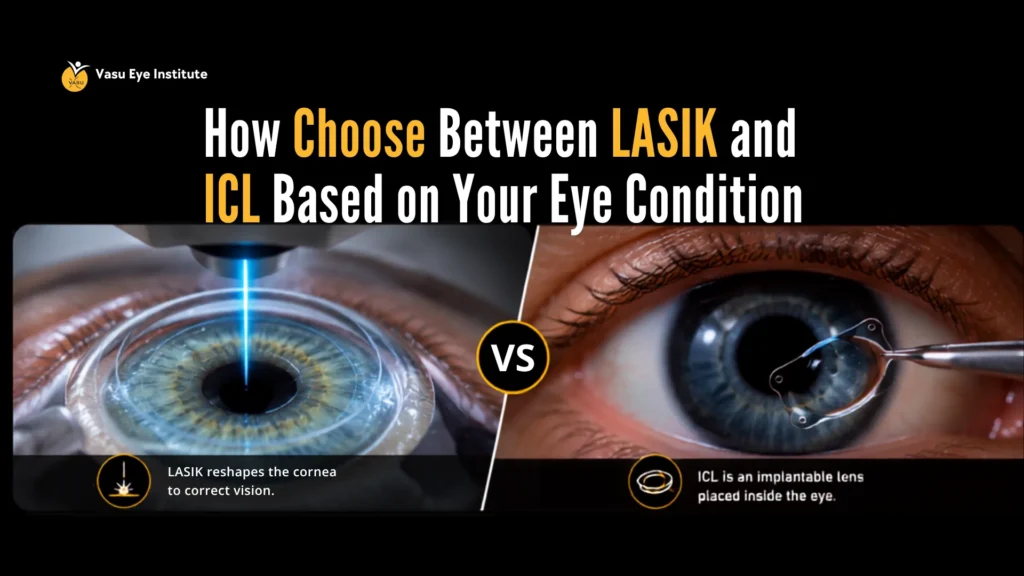
Choosing between LASIK and ICL depends on your eye condition, not only on which procedure is more popular. Both treatments can reduce dependence on glasses or contact lenses, but they work in different ways.
LASIK reshapes the cornea using laser technology, while ICL uses an implantable lens placed inside the eye. The right option depends on corneal thickness, eye power, age, lifestyle, and overall eye health.
Modern vision correction treatments can improve visual clarity when the patient is suitable for surgery. Whether can eyesight be improved by surgery depends on detailed eye evaluation, stable vision, and the type of refractive error being treated.
At Vasu Eye Institute, patients undergo advanced diagnostic testing before LASIK or ICL is recommended.
LASIK vs ICL Surgery Understanding the Key Differences
LASIK and ICL are both used for vision correction, but their method is different.
LASIK corrects vision by reshaping the cornea. It is commonly used for patients with suitable corneal thickness and stable refractive errors.
ICL corrects vision by placing a biocompatible lens inside the eye. It does not remove corneal tissue and may be suitable for patients with thin corneas or high eye power.
LASIK vs ICL Comparison
| Feature | LASIK | ICL |
| Procedure | Laser reshapes cornea | Implantable lens inside eye |
| Corneal Tissue Removal | Yes | No |
| Suitable For | Mild to moderate myopia | High myopia, thin corneas |
| Lens Implant | No | Yes |
| Recovery | Quick | Quick |
| Reversible | No | Yes, if medically required |
| Dry Eye Risk | May occur in some patients | Usually lower |
| Best For | Suitable corneas and moderate power | Thin corneas and high power |
When comparing laser eye surgery vs ICL, the decision should be based on eye structure and prescription strength. LASIK may be better for patients with healthy corneas and moderate power, while ICL may be better for patients with thin corneas or higher power.
LASIK May Offer
- Laser-based correction.
- No implanted lens.
- Fast visual recovery.
- Effective correction for many cases of myopia and astigmatism.
- Long-standing clinical use.
- Predictable outcomes in suitable candidates.
ICL May Offer
- Correction for higher eye power.
- No corneal tissue removal.
- Suitability for thin corneas.
- Good visual quality.
- Lower chance of dry eye in some patients.
- Lens removal option if medically required.
How Your Eye Condition Helps You Choose Between LASIK and ICL
Your eye condition decides whether LASIK or ICL is suitable.
Before treatment, the doctor evaluates:
- Corneal thickness.
- Eye power.
- Degree of myopia.
- Astigmatism.
- Tear film quality.
- Pupil size.
- Retinal health.
- Eye pressure.
- Prescription stability.
When LASIK May Be Suitable
LASIK eye surgery for myopia is commonly considered when:
- Myopia is mild to moderate.
- Corneal thickness is adequate.
- Eye power is stable.
- The cornea has a healthy shape.
- There is no major dry eye problem.
- The patient wants laser-based vision correction.
LASIK works well when the cornea can safely support laser reshaping. It is often preferred for suitable patients because it is quick, precise, and does not require any implanted lens.
When ICL May Be Suitable
ICL may be considered when:
- Myopia is high.
- Corneas are thin.
- LASIK is not suitable.
- Corneal tissue should be preserved.
- The patient has higher refractive errors.
- Lens-based correction is more appropriate.
For patients with very high myopia, ICL can sometimes provide better suitability because it corrects vision without reshaping the cornea.
The LASIK eye surgery age limit is also important. LASIK is usually considered when vision is stable and the patient is old enough for refractive surgery. The same stability check is also important before ICL surgery.
When deciding which eye surgery is best for myopia, the degree of myopia matters. Moderate myopia may respond well to LASIK, while high myopia or thin corneas may make ICL a better option.
Who Should Choose LASIK and Who Should Choose ICL
Both LASIK and ICL are highly effective vision correction procedures, but the final recommendation depends on a detailed eye examination rather than patient preference alone.
To determine the most suitable treatment, specialists evaluate:
- Corneal thickness and shape.
- Degree of myopia and astigmatism.
- Stability of spectacle power.
- Tear film quality.
- Overall eye health.
- Lifestyle and occupational requirements.
- Long-term visual expectations.
Some patients may be suitable candidates for both procedures, while others may have only one safe and effective option based on their eye condition. A comprehensive diagnostic evaluation helps identify which treatment can provide the best visual outcome while maintaining long-term eye health.
Which Is Better LASIK or ICL?
The answer to which is better LASIK or ICL depends on the patient’s eye condition.
LASIK is often preferred for suitable candidates because:
- It is laser-based.
- No lens is implanted.
- Recovery is fast.
- It has a long track record of successful outcomes.
ICL may be better when:
- The cornea is thin.
- The eye power is high.
- LASIK safety is limited.
- Corneal tissue preservation is important.
Both procedures are good. LASIK may be a better choice for many suitable patients, while ICL is a strong option when LASIK is not ideal.
Where to Go for Expert LASIK and ICL Evaluation and Treatment
The best way to choose between LASIK and ICL is through a detailed eye evaluation.
A complete assessment may include:
- Refraction testing.
- Corneal topography.
- Corneal thickness measurement.
- Tear film evaluation.
- Retinal examination.
- Eye pressure check.
- Pupil size measurement.
- LASIK suitability testing.
- ICL suitability testing.
The laser corrective eye surgery cost may vary depending on technology, eye condition, diagnostic tests, surgeon expertise, and treatment type. Cost should not be the only deciding factor because safety and suitability are more important.
At Vasu Eye Institute, specialists evaluate the complete eye condition before recommending LASIK or ICL. This helps ensure that treatment is selected based on medical suitability, safety, and long-term visual expectations.
LASIK and ICL are both effective vision correction options. For patients with healthy corneas and moderate refractive errors, LASIK is often preferred because it is laser-based and does not involve lens implantation. For patients with thin corneas or high power, ICL may be more suitable. The final decision should always be based on diagnostic evaluation.
FAQs
LASIK reshapes the cornea using laser technology, while ICL places a lens inside the eye to correct vision. Suitability depends on corneal thickness, prescription strength, and overall eye health.
A detailed eye evaluation checks corneal thickness, eye power, prescription stability, tear film, and retinal health. These tests help determine whether LASIK or ICL is safer and more suitable.
Both procedures are safe for suitable candidates. LASIK may be preferred for healthy corneas and moderate power, while ICL may be safer for thin corneas or higher refractive errors.
Thin corneas may reduce LASIK suitability because the procedure reshapes corneal tissue. In such cases, ICL may be considered because it corrects vision without removing corneal tissue.
Both LASIK and ICL provide long-term vision correction. However, natural age-related eye changes may still occur over time and can affect near vision or overall visual comfort.
Both procedures usually have quick recovery. Many patients notice improved vision within a few days, but complete visual stability depends on healing response and individual eye condition.
You need a complete refractive eye evaluation. Corneal thickness, eye power, eye health, and lifestyle needs help decide whether LASIK or ICL is the better option.