

Three different approaches can reduce dependence on glasses for selected patients. The right choice is not decided by a procedure’s popularity—it starts with the shape and health of your eyes.
If you are tired of depending on glasses or contact lenses, you may have come across LASIK, SMILE Pro and ICL. All three can reduce dependence on spectacles for appropriately selected patients, but they work in different ways. There is no single procedure that is best for everyone. The right choice depends on your prescription, corneal shape and thickness, eye-surface health, age, lifestyle and the results of a detailed pre-operative assessment.
This guide explains the broad differences so you can prepare useful questions for a consultation. It does not determine your eligibility. Devices, approved treatment ranges and clinical practice vary; your surgeon must confirm what is available and appropriate for your eyes.
LASIK uses a laser to create a thin flap in the cornea. An excimer laser then reshapes the underlying tissue to correct the refractive error, and the flap is repositioned. LASIK can treat selected cases of short-sightedness, long-sightedness and astigmatism, depending on the technology, the approved treatment range and the surgeon’s assessment. Since it changes corneal tissue and creates a flap, corneal maps, thickness and surface health are important parts of suitability.
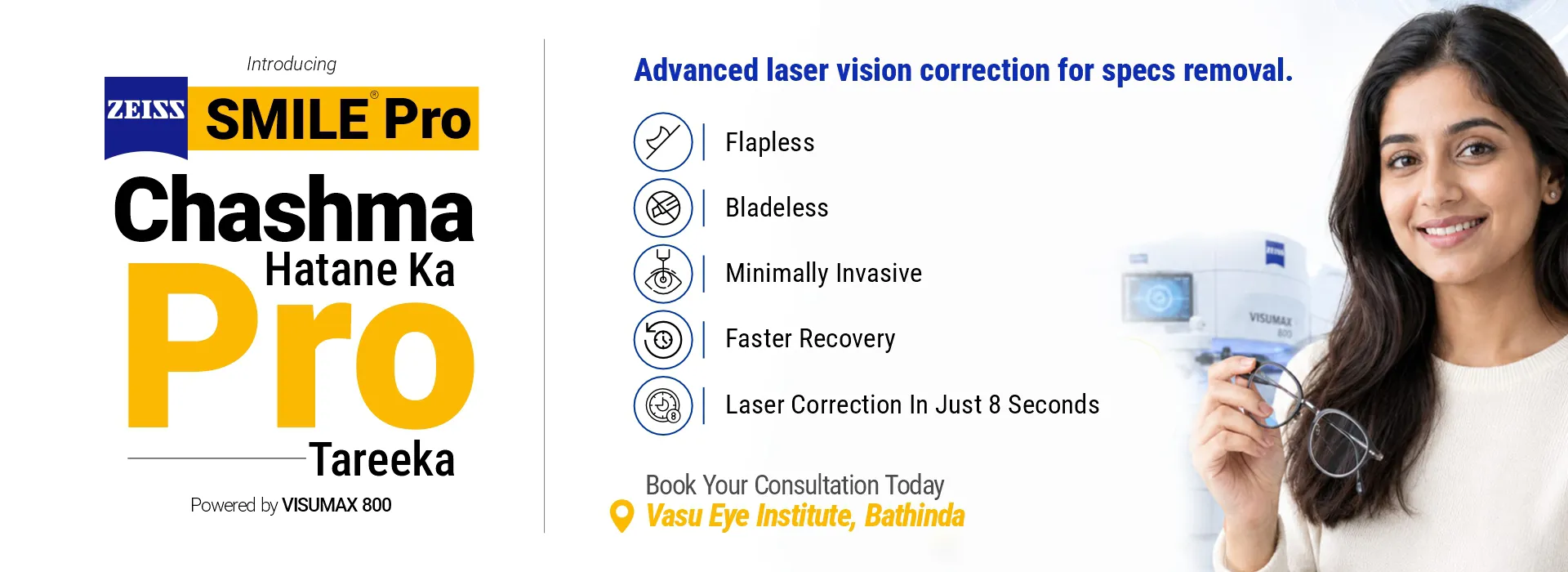
SMILE Pro is a small-incision lenticule extraction procedure. A femtosecond laser creates a lens-shaped piece of tissue, called a lenticule, within the cornea. The surgeon removes it through a small incision, changing the cornea’s shape. It avoids the larger flap used in LASIK and is commonly used for selected myopia, with or without certain levels of astigmatism, according to the system’s approved indications and the surgeon’s assessment. It is not automatically suitable just because it uses a small incision.
ICL, or implantable collamer lens, works differently. A specially selected lens is placed inside the eye, behind the iris and in front of the natural crystalline lens. The cornea is not reshaped to correct the prescription, and the natural lens remains in place. ICL may be considered for selected patients, including some with higher myopia or corneas unsuitable for corneal laser surgery. It is still an intraocular procedure and requires adequate internal eye dimensions and a healthy eye.
A procedure should not be chosen only because it is popular, advertised as newer or recommended by a friend. The assessment is designed to find out whether the eye can safely undergo a procedure and what visual result is realistic. The examination commonly includes a detailed spectacle prescription, review of prescription stability, corneal curvature and thickness, corneal topography or tomography, tear-film and dry-eye assessment, pupil and eye-health checks, eye pressure measurement and a retinal examination when indicated.
ICL candidates need additional measurements, including the internal space available for the lens and other checks relevant to safe implantation. Contact lens wear can affect some measurements, so the clinic may provide instructions about taking a break before testing. Follow the clinic’s timing; it depends on the lens type and the individual eye.
The clinician also needs to understand your expectations. Someone who drives at night for work, plays contact sports, has significant dry eye or has a very high prescription may have different priorities from someone who mainly wants convenience for everyday activities. Good counselling explains benefits, limitations, alternatives and possible complications before a decision is made.
LASIK and SMILE Pro both change corneal tissue, so the cornea must have a suitable shape and enough structural reserve for the planned treatment. A thin cornea does not automatically mean ICL is the answer; the full corneal map, prescription and other measurements must be considered. Irregular corneal shape or keratoconus can make corneal laser procedures unsafe and requires specialist assessment.
ICL does not remove corneal tissue to correct the prescription, which can make it an option for some patients who are not suitable for laser reshaping. But it is not a risk-free shortcut. The eye must have adequate space for the implant, and the surgeon considers possible changes in eye pressure, cataract, inflammation and other complications. The most useful question is not simply, “Are my corneas thin?” but, “What do my corneal shape, thickness, prescription and overall eye measurements show together?”
The amount and type of refractive error influence the options. LASIK and SMILE Pro are used for selected prescription ranges; suitable ranges vary by device, regulatory approval, corneal measurements and clinical judgement. ICL may be considered for some higher prescriptions, but not every high prescription is suitable for implantation. A prescription that is still changing can make elective surgery a poor choice because the result may not remain stable. Clinicians review prior prescriptions and may recommend waiting if measurements are changing.
Age matters, but age alone does not prove that a prescription is stable. A full assessment also considers astigmatism, differences between the eyes and other eye conditions. If keratoconus, significant ocular-surface disease, uncontrolled eye pressure or another condition is present, the priority may be to investigate or manage that issue instead of proceeding with refractive surgery.
A healthy tear film helps create a smooth optical surface, and dry eye can affect both pre-operative measurements and comfort after surgery. LASIK can worsen dry-eye symptoms in some patients. SMILE Pro avoids a LASIK flap and may affect corneal nerves differently, but it does not eliminate dry-eye risk. ICL avoids corneal reshaping, yet it does not automatically solve every tear-film problem.
If you experience burning, gritty sensations, watering, fluctuating vision or discomfort with contact lenses, tell your clinician. Dry eye and eyelid inflammation may need attention before measurements are finalised. Hiding symptoms to qualify for surgery is not safe; accurate assessment is more valuable than rushing towards a procedure.
Lifestyle can shape the discussion, but it should not override clinical suitability. People involved in contact sports or work with a risk of eye impact may wish to ask about flap-related considerations with LASIK and whether another option is appropriate. SMILE Pro has a small incision rather than a large LASIK flap, but choice still depends on the patient’s measurements and the procedure’s indications.
Night driving is another useful topic. Some people experience glare, halos, starbursts or reduced visual comfort in low light after refractive surgery. Risk depends on prescription, pupil characteristics, corneal optics, tear-film health and treatment plan. No method can guarantee perfect night vision or freedom from glasses in every situation.
| Option | How it works | Key assessment topics |
|---|---|---|
| LASIK | Reshapes corneal tissue under a flap | Corneal shape and thickness, prescription, dry eye, flap-related considerations |
| SMILE Pro | Removes a corneal lenticule through a small incision | Approved prescription range, corneal maps, thickness and eye health |
| ICL | Places a lens inside the eye while preserving the natural lens | Internal eye space, lens sizing, eye pressure, retina and overall eye health |
All surgical procedures carry risks. After LASIK or SMILE Pro, these can include temporary dry eye, glare or halos, under-correction or over-correction, infection, inflammation and, rarely, serious corneal complications. Some patients may still need glasses or contact lenses, and an additional procedure is not always appropriate.
ICL risks are different because the lens is placed inside the eye. Potential concerns include raised eye pressure, cataract, inflammation, infection, lens rotation or sizing issues, and the need for further surgery or lens removal. Careful measurements and follow-up help manage risk but cannot eliminate it.
Before surgery, understand how to use prescribed drops, when follow-up visits are scheduled and which activities need to pause during early healing. Do not use someone else’s medication or restart contact lenses, eye makeup, swimming or strenuous activity until the surgical team says it is appropriate. Instructions differ by procedure and person, so a generic recovery timeline may not fit your case.
Temporary blur, watering, light sensitivity or discomfort can occur after surgery, but severe pain, worsening vision, increasing redness or a sudden new symptom should be reported promptly. Attend all planned reviews even if your vision seems excellent, because healing, eye pressure and visual outcomes may need checking. Refractive surgery also does not stop age-related presbyopia; reading glasses may still be needed later in life.
Use the consultation to ask which procedures you are medically eligible for and why. Ask what measurements support the recommendation, what alternatives are available, which risks matter most in your case and what result is realistic. If only one procedure is recommended, ask why the others are less suitable. If several may be possible, discuss the trade-offs rather than focusing only on a brand name.
You should understand recovery, medication, follow-up visits, warning symptoms and the possibility of glasses after surgery. Request time to consider the decision. Elective vision correction should not feel rushed; a responsible recommendation may be to delay surgery or continue using glasses or contact lenses.
People considering laser vision correction in Bathinda and the Malwa region can arrange an assessment at Vasu Eye Institute & Skin Centre. The team can review the eye and explain available options based on individual findings. Confirm directly with the clinic whether a specific technique is currently offered and whether it is suitable for you.
Bring current and previous glasses prescriptions if available, details of contact lens use, relevant medical history and a list of medicines. Be ready to discuss dry-eye symptoms, previous eye injuries, family history of corneal disease and visual tasks that matter most. A tailored assessment—not an online comparison—is the foundation of an informed decision.
LASIK, SMILE Pro and ICL can all reduce dependence on glasses for appropriately selected patients, but they are not interchangeable. LASIK and SMILE Pro reshape the cornea in different ways; ICL places a lens inside the eye while leaving the natural lens in place. Corneal shape and thickness, prescription, tear-film health, internal eye measurements, lifestyle and expectations all influence suitability.
The best option is the one supported by a thorough examination and a clear discussion of benefits, risks and alternatives—not simply the newest or most heavily promoted procedure. If none is suitable, glasses or contact lenses remain valid ways to correct vision. Ask for an explanation that makes sense to you before agreeing to elective surgery.
There is no universal winner. Suitability depends on prescription, corneal shape and thickness, tear film, internal eye measurements and lifestyle.
Not automatically. Suitability depends on corneal shape, thickness, prescription and the planned treatment. A specialist must review the full measurements.
They have different benefits and risks. LASIK reshapes the cornea, while ICL places a lens inside the eye. The suitable choice depends on clinical findings.
Dry eye should be assessed and, where needed, treated before surgery. Significant or uncontrolled dry eye may make some procedures unsuitable.
They can reduce dependence on glasses, but residual prescription, later changes and age-related near-vision difficulty can mean glasses are still needed.
Keratoconus generally makes corneal laser reshaping unsuitable. A cornea specialist should assess the condition and discuss alternatives.
Educational information only; not a substitute for examination, diagnosis or treatment. Confirm all procedure availability, indications and clinical details with the hospital before publishing.